Introduction to the IR
ONNX IR is an in-memory representation of ONNX models for graph construction, analysis, and transformation. It represents the full ONNX specification while providing Python-native objects and mutation APIs that are more convenient than editing protobuf messages directly.
This page explains the IR’s design principles, object model, and major features. For a hands-on walkthrough, see Getting started with ONNX IR.
Design principles
Preserve the ONNX model
The IR maps closely to ONNX concepts so models can be loaded, inspected, changed, and serialized without losing information. It supports all valid ONNX models and also permits some temporarily invalid states, which is useful when a transformation needs several steps to repair or rewrite a graph.
Make graph relationships explicit
Connections are represented by object references instead of repeated string
lookups. A onnx_ir.Value knows its producer and consumers, a
onnx_ir.Node owns its output values, and a
onnx_ir.Graph owns an ordered collection of nodes. These relationships
make common analysis and rewriting operations direct and efficient.
Support safe, local mutation
Graph edits update the relevant ownership and use-def relationships. The graph’s node container supports insertion and removal during iteration, so transformation passes can edit a graph without first copying its node list.
Nodes are stored in a deterministic order, but the IR does not automatically topologically sort them. Transformations are responsible for preserving or restoring topological order when required.
Separate representation from serialization
ONNX protobuf is an interchange format; it does not need to be the working data
structure. After deserialization, the IR can be used without manipulating protobuf
objects. Serialization and deserialization are explicit boundaries through
functions such as onnx_ir.load(), onnx_ir.save(),
onnx_ir.from_proto(), and onnx_ir.to_proto().
Avoid unnecessary tensor copies
Tensor data is accessed through onnx_ir.TensorProtocol, which allows
the IR to work with different storage backends through one interface. Implementations
include in-memory arrays, protobuf-backed tensors, memory-mapped external tensors,
lazy tensors, and packed low-bit tensors.
Object model
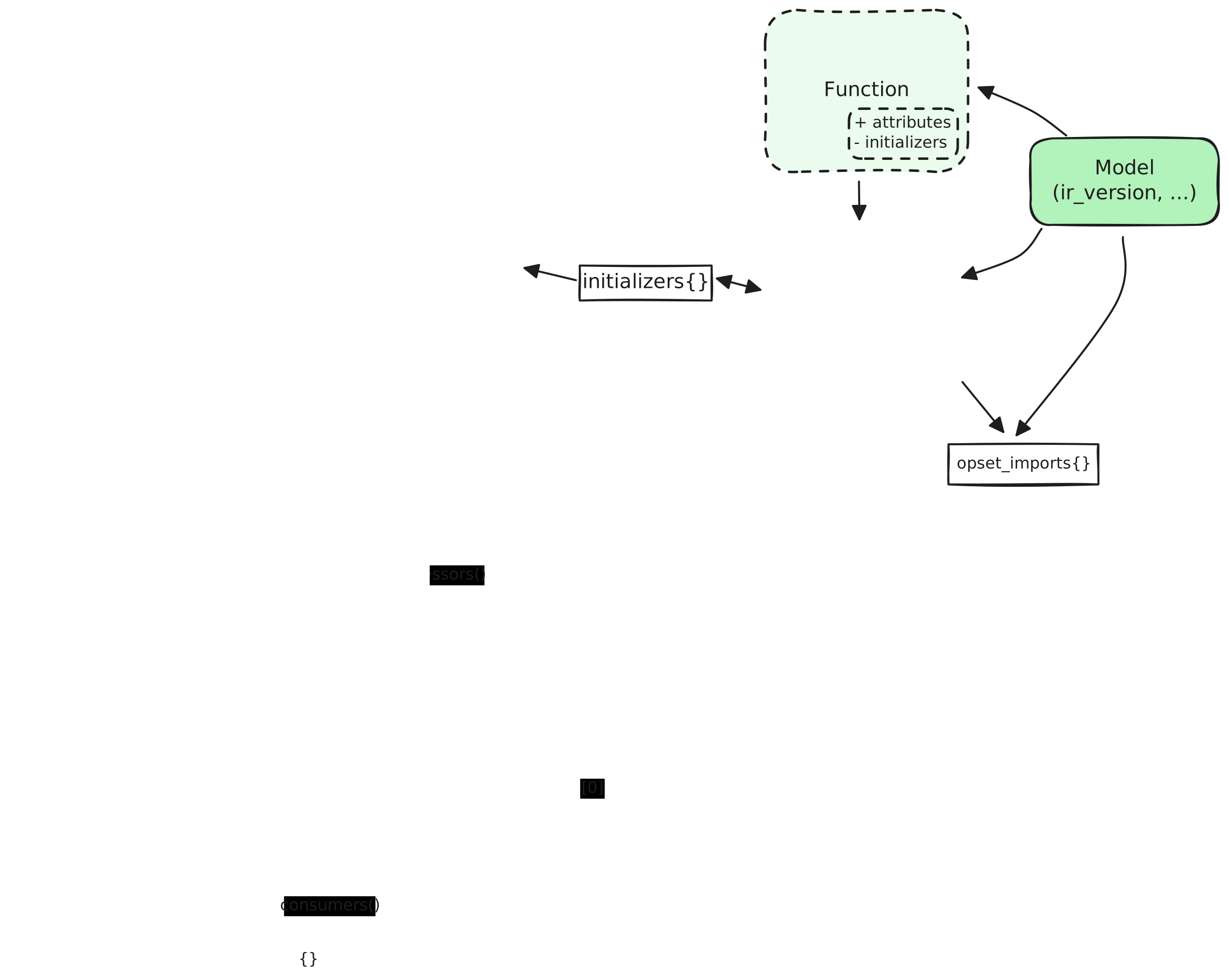
Model
A onnx_ir.Model is the top-level container. It holds:
the main graph;
the ONNX IR version;
producer, domain, version, and documentation information;
model-local functions;
serializable metadata and multi-device configuration.
Graph
A onnx_ir.Graph represents a computation and behaves as a sequence of
nodes. It also owns graph inputs, graph outputs, initializers, and opset imports.
Subgraphs stored in node attributes use the same graph representation.
Use a onnx_ir.GraphView when an analysis needs a read-only view over a
subset of nodes. A view does not copy or take ownership of its nodes, and changes
to the underlying connections remain visible through the view.
Ownership and graph invariants
The IR maintains ownership and use-def relationships as graph objects are edited:
A node belongs to at most one graph. Remove it from its current graph before inserting it into another one.
A node owns its output values. Each output therefore has exactly one producer.
Graph and function inputs have no producer.
An initializer must be named, have a constant value, and have no producer.
Graph outputs reference existing values; they are not a separate copy of those values.
Use graph.remove(nodes, safe=True) for removal. Safe removal rejects nodes whose
outputs are still used or contribute to graph outputs, then detaches the removed
nodes from their inputs so use-def information remains consistent.
Node order is deterministic but is not automatically topological. Call
graph.sort() after a rewrite when the transformation does not naturally preserve
topological order. The stable sort also processes nested subgraphs and raises
ValueError if it finds a cycle.
Views and clones
A onnx_ir.GraphView provides a fixed, read-only topology over existing
nodes and values. It is useful for analysis or serialization of a region without
copying that region.
Use graph.clone() or model.clone() when the result must be independently
mutable. Cloning creates new graph, node, and value objects while sharing tensors
used by initializers and constants. Pass deep_copy=True to also deep-copy
analysis metadata stores. When cloning a nested graph independently, set
allow_outer_scope_values=True if its captured outer-scope values should remain
shared.
Node
A onnx_ir.Node represents an operator invocation. It stores the
operator domain, type, overload, attributes, inputs, and output values. Node
inputs may be replaced, while output values are fixed when the node is created.
To replace outputs, create a new node and redirect uses of the old values.
Nodes also provide direct graph-neighbor traversal. predecessors() returns the
nodes that produce the node’s inputs, while successors() returns the nodes that
consume its outputs. Both results are deduplicated and have deterministic order:
predecessors = node.predecessors()
successors = node.successors()
Value
A onnx_ir.Value represents data flowing through the graph. A value can
be a graph input, initializer, node output, or graph output, and may carry type,
shape, constant data, documentation, and metadata.
Every value has at most one producer and can have many uses. The producer/use links support both directions of graph traversal:
producer = value.producer()
consumers = list(value.consumers())
uses = list(value.uses())  # Each use includes the node and input index.
Types, shapes, tensors, and attributes
onnx_ir.Value objects carry ONNX types such as tensor, sparse tensor,
sequence, and optional types. Tensor shapes are represented by
onnx_ir.Shape and may contain static integer dimensions or shared
onnx_ir.SymbolicDim objects. A symbolic dimension can store a SymPy
expression, enabling shape arithmetic that can later be evaluated with concrete
symbol bindings:
import sympy

import onnx_ir as ir

batch = sympy.Symbol("batch", integer=True, positive=True)
shape = ir.Shape(
    [
        ir.SymbolicDim(batch),
        ir.SymbolicDim(batch * 2 + 1),
    ]
)
concrete_shape = shape.evaluate({"batch": 4})  # Shape([4, 9])
Constant data uses the onnx_ir.TensorProtocol interface. Operator
attributes use onnx_ir.Attr and can contain scalar values, sequences,
tensors, graphs, types, and ONNX function attribute references.
Subgraphs and functions
Control-flow operators store subgraphs in node attributes. A subgraph can
implicitly capture values from an enclosing graph in addition to declaring its own
inputs, initializers, and outputs. Each graph also carries its own opset imports.
Use onnx_ir.traversal.RecursiveGraphIterator or graph.all_nodes() to
visit nodes in nested subgraphs.
A onnx_ir.Function defines a reusable, model-local operator identified
by (domain, name, overload). Like a graph, it owns inputs, outputs, nodes,
attributes, and opset imports. Functions are stored separately from the main graph,
so analyses and transformations that apply to the whole model should process both:
for node in model.graph.all_nodes():
    analyze(node)

for function in model.functions.values():
    for node in function.all_nodes():
        analyze(node)
Names and identity
Objects are connected by identity, not by their names. Names are primarily for serialization, diagnostics, and lookup.
When an unnamed node is added to a graph, the graph assigns names such as
node_Relu_0; unnamed outputs receive names such as val_0. Explicit names are
preserved, even if they collide, so callers remain responsible for the uniqueness
of names they provide. Automatically generated names are reserved for the lifetime
of the graph and are not reused after removal.
Run onnx_ir.passes.common.NameFixPass when an imported or transformed
model may contain missing or duplicate names. It handles nested graph scopes,
updates initializer mappings, and processes model-local functions:
import onnx_ir.passes.common as common_passes

result = common_passes.NameFixPass()(model)
model = result.model
Pass a custom NameGenerator to NameFixPass when generated names should follow
a project-specific convention.
Renaming an initializer also requires updating the graph’s initializer mapping.
Use onnx_ir.convenience.rename_values() for collision-aware bulk renaming
that handles initializer bookkeeping when only selected values should change.
Major features
Full ONNX coverage
The IR represents models, graphs, functions, nested subgraphs, opset imports, attributes, type and shape information, metadata properties, external tensor data, and newer model features such as multi-device configuration.
Use-def tracking
Producer and consumer information is maintained by the IR. Rewriters can inspect uses, replace node inputs, replace all uses of a value, and safely check whether a node can be removed.
Robust graph editing
Graphs provide methods to append, insert, remove, and reorder nodes. Iterators
remain usable while nodes are inserted or removed, enabling single-pass
transformations. Higher-level helpers for common rewrites are available in
onnx_ir.convenience.
Flexible tensor storage
Tensor implementations can wrap NumPy-compatible arrays without an eager protobuf
conversion. External tensors use memory mapping to avoid loading entire weight
files into memory, and custom tensor implementations can implement
onnx_ir.TensorProtocol to integrate other storage systems.
See Tensor Representation in the IR for details.
Serializable and analysis-only metadata
IR objects expose two metadata stores:
metadata_propscontains string key-value pairs that are serialized to ONNX.metacontains arbitrary Python objects for analyses and transformations and supports invalidation when cached information must be recomputed.
Keeping these stores separate lets passes attach rich intermediate state without accidentally changing the serialized model.
Pythonic APIs
Core entities use standard Python collection interfaces: graphs and functions are
node sequences, attributes and initializers are mapping-like containers, and graph
inputs and outputs are mutable sequences. Convenience constructors such as
onnx_ir.node(), onnx_ir.val(), and onnx_ir.tensor()
reduce boilerplate when constructing models.
Where to go next
Getting started with ONNX IR for loading and exploring a model.
Graph transformation patterns for common rewrites.
Writing transformation passes for reusable transformations.
Model I/O and external data workflows for serialization.
API Reference for the complete public API.